Search This Blog

Monday, September 24, 2012

Gone With The Wind!


Well the Santa Rosa storm that usually occurs in the last week of August never materialized but the month of September more than made up for it weatherwise.

The first week of September started in dense fog. For several days it thickened and a strange erie glow settled down upon us. Fog has a way of darkening the day but at the same time like frosted glass it diffuses light, so the days were incongruously dark and light. Air traffic was delayed, some planes were rerouted through Chili and for a few hours the airport closed during the thickest part of the day.

  
Days after the fog we had a reprieve with some very warm days that reminded me summer was just around the corner. Wally even bought a fishing pole and had some great ambitions (dreams) of catching fish but that's another post! Oops! No summer yet. The weather took a turn for the worse and it poured and poured down rain which proved to be a problem later on in the month.


After a few days when the rain finally stopped a beautiful double Rainbow appeared! This rainbow was so spectacular that photos of it appeared on many a Facebook site. Our neighbors took turns taking photos of each other with the rainbow behind them. It was so oo the thing to do that I couldn't help but snap a photo of Wally in front of it. He even hinted that we should run down to the beach and start looking for the fabled "POT OF GOLD" supposedly located at the end of every rainbow. The rainbow was that close to our house and bright that we thought it ended on the stretch of beach right in front of our house.


Usually a Rainbow comes at the end of a storm but as to weather, the big news out of Uruguay for September has been a fierce Tropical storm, a spring cyclone originating from Brazil. Almost hurricane strength winds blew for 2 days, howling away while trees swayed. During the worse of it we watched the TV news along with many others. The News warned everyone to stay home in their houses. Emergency telephone numbers were flashed. Scenes of Montevideo, the countries' Capital City showed firemen battening down the hatches. Later reports from people who work downtown in MVD said it was too dangerous to walk the streets as many high-storied apartment buildings windows' burst, raining down broken glass below. Cars had debris crush their tops from loose flying metal and garbage can lids. I have now learned that 2 people died in that storm, a father and son crossing a bridge. Many people were injured and even the President of this country, President Jose Mujica had his nose cut by flying debris.


Our power was intermittent during Wednesday, with lights flickering. Finally during the night on Wednesday September 19th. the winds blew so hard that havoc struck. Many trees came down with a roar. Thursday morning we awoke to no electricity. It was like the movie "The day After". The day itself was strangely calm because the winds had cleared the skies but the ground was littered with debris and trees branches.  I discovered that the lone pine tree in my neighbor's yard, a subject of many of my photos including the title photo of this post had broken in half taking down both our neighbor's and our power lines (the telephone line was dangling but working).


Since we had no power I went around the block checking on the damage to our neighborhood, taking photos. Across the street a neighbor who lives in Montevideo had their neighbors tree fall down in front of and blocking their house. The driveway way now blocked. I called them to let them know. The husband was worried about their newly installed Swimming pool but in my broken spanish I assured them the tree had fallen outside their property they just couldn't use the driveway. Of course that tree took out more power lines.


The wind Wednesday night was so strong that huge trees were simply uprooted and fell down along their entire length. One neighbor, a couple of blocks away, said she had quince trees (15 trees) come down! I had guessed 5 large ones but no, 15 she kept saying! It was a miracle that her house was still standing! All of the trees surrounding her house fell toward the street and not inward. Of course they brought down more power lines! After getting estimates for removing the fallen trees the cheapest she got was 800 pesos per tree and she had quince/15! However she was able to trade the work for the wood itself and thus save a small fortune. The sound of Gardeners and chainsaws filled the air on Thursday.


One house towards Salinas (the town nearby me) did have a tree fall on it's roof. I didn't see a crack in any of the walls though. I think the tree was just short enough to not have it's full weight land on the house but just it's top. Still, how scary to live through that!


Not since the year 2005 has such a strong wind storm occurred. It is said that Brazil knew before we did that we would experience the storm but that because of antiquated equipment and little money our weather-forecasters were not equipped to give an advanced warning. So talked about going on strike in protest.


About 10% of Uruguay has lost electric Power because of the storm and fallen trees. While most of my neighbors on my street seem to have power, we are in that 10%. It has been 5 days now that we are without lights, TV and yes internet! I have written this post on my portable laptop on battery power.

Crews are out fixing downed power lines as quick as they can. We do have telephone service so we were able to report our loss. Our refrigerator and freezer has now been emptied of food. Fortunately the storm hit the day before our feria food run so that we didn't have a weeks worth of food go rancid. The dogs enjoyed the last of our hamburger. The good news is that for a couple of days it's been sunny so that our Solar water heater (which didn't blow away) has provided us with hot showers. Our wood stove works with an electric blower so we can't use that but I bought last year a portable gas heater so we are keeping warm with that unit. Since we use tanks of super gas to cook with we can go to the store and buy food to cook with for the day, and of course, we have flashlights and candle power.

   
Still we can count our blessing! If you remember in earlier post our next door neighbor put a new roof on his house and he was concerned about our 2 towering pine trees. Well, he agreed to pay for their removal, and now how glad I am that they were gone before this storm arrived! Also, 2 visitors from the States, Lauren and Tim gave us a little gift of 3 candles when they left. Lauren had remarked how expensive they were and that since they were leaving the country to return back home they thought they'd give them to us. Well, little did we know then how much we would be grateful for that gift! While our other candles burned down in just a few hours those little candles in their holders lasted for 4 days! I guess you do get what you pay for! Many a neighbor has offered his house for cooking or showers but we had that covered. A bag of lemons mysteriously appeared on our doorstep. We were able to make cold tap water lemonade. So a big "Thank You" to whoever left that bagful.


Also, we are Thankful that we were able to attend our 3 day District Assembly smack-dad in the middle of all of this. We had our bus tickets prepaid and the Assembly Hall (several cities away) had heat and lights and Bible discussions all day so we were surrounded by our Christian friends.

The power just came on in our house but it's still iffy. When more than two lights are on they start to dim and flicker. I am publishing this post as quickly as I can while the power holds. Tomorrow, the 25th of September we are expecting a smaller wind storm. The winds have already started so let's hope we weather through this one as safely as the last. 

Saturday, September 8, 2012

Colonia Weekend!


Wally surprised me by suggesting a trip up to Colonia del Sacramento for our 39th Wedding Anniversary, so of course!/ por supuesto! I said, "YES"  and we went.

Our Krispy Cream, the name given to our VW bug is way too unreliable for long distance travel so we decided to bus it there.

Colonia is about 177 kilometers (109 miles) away from the capital of Uruguay, Montevideo, it takes about 2 hours and 45 minutes to get there by tour bus.


We started our trip early in the morning by catching our local city bus that runs along the highway by our town. The cost was 38 pesos (almost 2 dollars) each, for the 1 hour bus trip (lots of stops along the way) to Tres Cruces, the bus terminal located in Montevideo.  The day started out freezing, literary which is unusual for Uruguay even in the winter. The day before, I had taken a picture of frost on our lawn, so I made sure to wear my heaviest coat and was I glad of that.


Here is a picture of Wally trying to show how cold the city bus was by blowing smoke out of his mouth using his breath. Notice how bundled up the person next to him is dressed. I was amused that the seat in front of me had the words "The Rolling Stones" graffitied on it's back, that's what I felt we were like that morning, a couple of old rolling stones. As a side note, back up in the USA our anniversaries were in Summer, so coming up with things to do in the cold rainy winters here in South America have been challenging. When we finally got to Montevideo that morning a temperature sign said it had warmed up to 1 degree Celsius (33.8 F).


The fare from the main Tres Cruces bus terminal to Colonia was a very reasonable 235 pesos (rounding up) for each person, each way . That included tax. So for about $11.19 for each person and each way, the whole bus trip cost about $45 roundtrip for 2 people, such a deal! That was a lot less than we would have paid for gas. The tour bus (photo above) to Colonia unlike the city bus was clean, comfortable and nice and warm with large windows and a bathroom at the back. So off came our coats and we settled in for the ride.

View of Ferry terminal and Fort remains.
Colonia del Sacramento is the oldest town in Uruguay, it was founded in 1680. It was built by the Portuguese. It was the only Portuguese colony among the many other Spanish ones at the time.  Manuel de Lobo a Governor of Rio de Janeiro, Brazil was ordered by the Regent Prince of Portugal to establish this settlement. It was a walled city with a fortress. The city sits on the tip of a peninsula, jutting into the Rio de la Plata and it was once used as a smuggling base for raids across the river. Buenos Aires, Argentina once under Spanish rule, lies across the river from this town. Interesting to note is that Colonia is a 1 hour time difference ahead of Buenos Aires. That's important for your return trip.

The bus terminal is about 1 kilometer away from the historic section and the ferry terminal is closer at about 1/2k (20min.walk). The regular, newer part of Colonia has many stores and restaurants and etc...

To get to Colonia from Buenos Aires you can take the fast boat (catamaran), it takes 50 mins. each way to travel across the Rio del la Plata or you can take the slow ferry called the Buquebus that takes 3 hours! The 3 hour trip is down right cheap (about 120 pesos each way)  the faster boat can cost from $70-$110 dollars (USA). You are paying for the speed, less than 2 hours for a round trip versus a 6 hour roundtrip. Obviously if you want to spend just a day in Colonia the faster boat ride won't use up your entire day in travel alone. Once you arrive in Colonia, across from the ferry terminal is a car rental place called "Thrifty car rentals".

Rented Golf Cart for sightseeing.
I mention that because, besides cars, it rents bikes and golf carts that can be driven to the nearby beaches and used throughout the city.

During its history, Colonia's ownership jumped back and forth many times between the Portuguese and the Spanish Vice Royalty. It was even razed to the ground once (1705) and rebuilt immediately. It was finally, given over to Uruguay when Uruguay was recognized as an individual sovereignty (1825).


The original gate and drawbridge into "Old" Colonia.
What makes Colonia an interesting place to see is that it is a World heritage Site declared thus by UNESCO in 1995. Its Barrio Histórico (old section neighborhood) is a fine example of Portuguese architecture. Once you enter through the old city gate (Portón de Campo) and across the wooden draw bridge, the streets are cobbled stoned and irregularly planned, unlike Spanish streets.


The buildings are charming, quaint and a photographer's delight to snap. There are yellow lanterns hanging on buildings. Some of the cobble stones seemed to have once been petrified wood perhaps some old wooden planks now turned to stone and used to pave the old streets.Watch your step, the cobble stones could maim you being as irregularly laid as they are.


Colonia has 2 plazas or town squares (parklike gathering areas). In the Plaza Mayor (main plaza) one of the first things that you see is the lighthouse (faro) built in 1857 next to the remains of the 17th century convent, the Convent San Francisco (now in ruins).


This time I definitely took advantage of exploring the lighthouse unlike the time I missed the one in La Paloma. I bought the 20 peso ticket (about a buck, US) so that I could climb to the top of the 88ft/27m lighthouse and see the view from up there (Wally doesn't do heights). The stairs were very steep. The view was amazing from the platform but then I learned that you could also climb higher, up a ladder and go inside the lantern room and then outside to another platform, so I climb up some more, higher still.


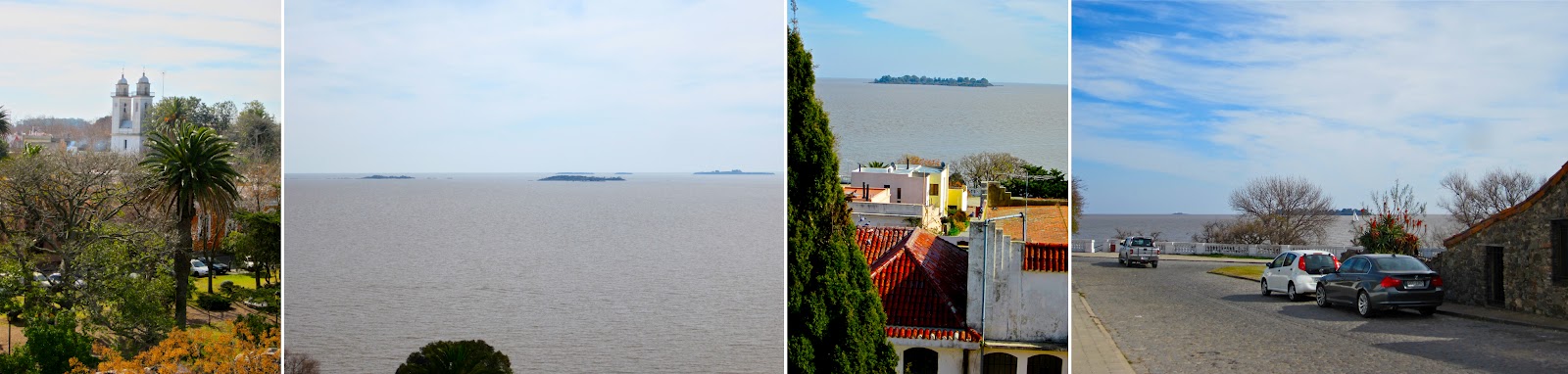
The view was worth the trouble/Vale la Pena. What struck me was that there are nearby islands just off the coast in the river (in Argentina waters). One island, about 3.5 kilometers away has another lighthouse on it. The last photo while not taken from on top of the lighthouse, shows the island with the other lighthouse on it.


Colonia has many charming dinning spots tucked into every nook and cranny. One is in an old round mill tower that has now been turned into a restaurant. Another popular place is called El Drug Store, a colorful place with an antique car parked outside. If there are only 2 of you and you reserve the car ahead of time, you can eat inside the car at a tiny table between the steering wheel and the back seat, while sitting on the back seat like a booth. A friend named Syd wrote about eating at the restaurant, he ate inside the building. The menu was extensive and the food he said was good and reasonable about $20 per person, on the weekends there is live music to eat by. When in Colonia make sure to look into every doorway in order to scout out a restaurant or ice cream parlor. Be aware that many of the restaurants charge a cover charge, added to your bill, it's called a "cubierto".  Because this is a tourist spot (trap is too harsh) these cover charges can be expensive, anywhere from 70 pesos on up, depending on the individual restaurant. Many places have this amount listed outside but ask first.


By far the most charming Colonia mealtime atmosphere came however from the many scenes of outdoor dinners eating at tables in the streets. Go on a warm/ hot day and definitely eat outside along with the others to really feel like you are on vacation. That gives you the so-called European vibe that people claim Uruguay has over other Latin American countries.


Colonia has about 8 different mini museums and you can buy a single general admission ticket at the municipal museum that allows you to enter them all (or most???) These museums range from examples of furniture, architecture, archives of the history of the area, nautical finds and Pirate lore, there is even a tile museum (blue and white mostly). So keep your ticket.

Wally and I found out (to late for us to use) that there is also a tour bus circuit, like Buenos Aires had, which features 10 places of interest, lined out on a bus route map. You can buy a "day ticket" and hop on that bus and hop back off at will, at any and all of the designated stops to see the landmark/sights. I believe you can buy the ticket either on the bus or ask at the tourist info. building outside the old Gate.

The beauty of Colonia is being able to take your time and peek into nooks and crannies to discover lovely vignettes. Look up and notice the Spanish moss growing on the trees. Palm trees, orange trees full of fruit in the main square and sycamore trees line the streets.


Uruguay is a small country and Colonia is a small town, many people say, it only takes a day to sight see in. Of course, you are missing the point of Uruguay all together, if you were to take that attitude about everything here. Uruguay is a peaceful, relaxing country in comparison to say, Argentina, so whenever visiting Uruguay slow down. Don't expect to be constantly entertained, wowed and hustled from one sightseeing land mark to another, take your time, relax, go to the beach or just wander around slowly enjoying the moments, look for the micro views in addition to the bigger picture. Sometimes we have to be reminded to "STOP and smell the roses" and that takes time.

Monday, August 20, 2012

The Train Station, Old and New!


I love looking at stately old buildings and imagining what they were like in their glory days. Most of my early photos albums have more pictures of places than people in them (yeah, kind of sad). Still, I love architectural design so I usually snap a photo or two of some structure whenever I go out.


Montevideo, the capital city of Uruguay has often been touted as a very European inspired city rather than, an adobe pueblo style that people might imagine a Latin American country would be like.

The old, General Artigas Central Railway Station is a beautiful example of Victorian architecture. It was the former central railway station of Montevideo. It is located near the port area between the streets Paraguay, and Rio Negro in a barrio (neighborhood) called Aguada.

It is truly heartbreaking to see such a grand building left to decay and squalor. There are several U-Tube videos online showing the extent of this degradation. So suddenly, has it deteriorated that I had to find out when it was built and when it was last used as a working station.


The station opened, July 15, 1897.  Built by the English when they were the owners and directors of the Uruguayan railway system here (which was nationalized in 1949). It was designed by an Italian engineer/architect named Luigi  Andreoni (Luis) who also designed other buildings in the capital city such as the neoclassical Italian Hospital (founded in 1890 and located in the Tres Cruces area at the intersection of Avenida Italia and Artigas Blvd; and also the Club Uruguay (of the year,1888) located in the Plaza Matriz.

Despite being called the General Artigas Station (a local Hero here) the front of the station has not only a statue of the General but several statues of other famous historical personages as well. One is a statue of Denis Papin who among other things was an inventor known for his "steam digester", the forerunner of the stream engine. James WattGeorge Stephenson and Alessandro Volta are the other people who have statues in their likenesses here.

Because this is such a little country with limited finances it was determined that Railway service and especially passenger service railway lines were too costly to maintain. Carrying freight by trucks and Bus service for passengers was pushed as an alternative, (some heavy load cargo trains have continued to be used). Long distant passenger service trains ended their routes.  Most of the nearly 2,900 km of railway tracks in this country have declined into disuse. Many little railway stations are abandoned. The majority of the passenger lines stop being used in 1988. The current president José Mujica originally made election promises to revitalize these lines and some 422 km are being renovated.

There is a movie that highlights the end of this train era for Uruguay. The movie is called, El último tren (The last Train). It's a 2002, comedy/drama that was shown at the Montréal World Film Festival and won a film honor for Best Latin-American Film. The movie is set in Uruguay, it shows how special the trains were to the people of Uruguay.


The last train of passengers inbound, ever to use this old central station arrived there, February 28th, 2003 at 21:25 (9:25pm), the last train to leave this station then left empty at 21:40 (9:40 pm.) and on February 28th, 2003, the station was closed. Many people here remember visiting this old station when it was alive and well and have remarked on its beauty. The iron work used in it's iron fretwork was imported from a foundry in the district of Derbyshire, England, the Andrew Handyside and Co. foundry. It had to travel almost 7,000 miles (6820.77 miles 10976.9 km.), halfway around the world in 1895 to get here.

Some groups tried to save this station for its original purpose. For awhile (in 2005) one such group called the "Group of passengers for the defense of the central station", seemed like they would be successful. People talked about the freight trains and passenger trains returning to this station as well as making this "historical monument", viable as an income producing source if the Ministry of Tourism were to also get involved. They failed to get the governments' support. Earlier, in 1998 the State Railway Administration or Administración of ferrocarriles del Estado (AFE), sold the station (and 6 hectares of land) to the Real estate mortgage bank of Uruguay (BHU). From these sales the AFE used part of the money to build a new modern railway station about 1/2 mile north of this site. The money they are saving from the repairing and upkeep of the old station they feel, they can invest in other railway projects. The AFE restored an old steam engine and 2 passengers cars that I posted about last month.

Abandoned building with imported English ironwork trim.
It has only been 9 years since this station has been completely abandoned with zero maintenance and the results are shocking! Vagrants sleep in its doorways. The smell of urine abounds and the ceilings inside, what's still left of them that is, leak. I would have explored a little inside (there are wide gaps in the lockout fence) but the area is desolate and dangerous now. Walking by it during the day wasn't so bad but in the evening avoid this area. There are currently no plans in place to revitalized or reuse this train station.

Empty train yard and buildings of the old station.
The new central railway station for Montevideo, is a modern style building, it's a walkable 1/2 mile (to the north) from the old one. It was opened March 1st, 2003.  It is very,very small in comparison with the older one. It has only 3 tracks with little maneuvering grounds for the trains, such as freight trains. There is some passenger service that uses this new station, the few commuters from nearby towns use this station. There is service to the city called August 25 (25 de Agosto), and also to the barrio of Peñarol. Schedules have to be checked though.  


Trains and train service nowadays in Uruguay can't compare with the glory days of service when the iron rail ruled but there have been some attempts at rethinking the value of the rail. There is talk of a train service from Buenos Aires, Argentina to Montevideo, Uruguay, a joint venture between the two countries. A test run took place in September, 2011. Let's hope the future will see a few more opportunities to ride by rail.

I also hope that the old central station will be restored one day (for whatever, honorable use). That structure, along with the many other beautiful but decaying buildings in Uruguay all deserve attention. There is such a rich history here in Uruguay and such old buildings help keep that history alive.

Tuesday, July 31, 2012

La Barra and Its Art!


Well, our weekend guests have gone back to the USA. They spend their time between the United States and their future retirement condo in Buenos Aires, Argentina. You can take a peek at Tom and Nancy's  place (by clinking on the link) from the time we visited them in Argentina a few years ago. I must say, how pleased I was at how well our tiny little guest room functioned! Barney (our black dog) jumped up on Nancy (only once) when she first came into the house and I'm afraid that soured things a bit for her. Our dogs always get excited on arrivals. They were great during the visit except for that incident.

One benefit of having house guests stay over is getting my house into "super clean" picture perfect mode. Another side benefit is playing, tour guide and seeing places we normally don't get to visit. These house guests like to go to museums and art galleries, so we went up the coast to La Barra.


La Barra is past Punta Del Este by just a smidgen (20 kilometers from the peninsula). When going to La Barra after leaving the back side of Punte del Este you get to go over the short but famous "Wavy bridge".  It was designed by an Uruguayan engineer named Leonel Viera back in 1965. Nowadays, there are actually 2 undulating (wavy) bridges parrelling each other . Each one serves a different traffic direction (one way each)  It's a fun sight for visitors to see and cross over as you leave Punta Del Este. La Barra is just one of the many beach towns up the coast. The name La Barra comes from the term sand bar. The estuary formed by the Maldonado creek (Fresh water) is barred from totally mixing with the Atlantic Ocean (salt water) by, you guessed it, a large sand bar. Depending on the weather however, the size and shape of this natural barrier can sift and change.

La Barra used to be a small fishing village and a second summer home choice for vacationers from the nearby town of San Carlos. It has since morphed into a swinging neighborhood bar hopping, all night clubbing destination spot for the young. It has a well known beach hangout called bikini beach, that is a party zone with a Beach DJ and drink service.

La Barra unfortunately is no longer a bargain. Hotels and Restaurants there are very expensive, drawing the rich and famous from nearby Punta Del Este. Bar hopping often starts at sunset and then the night clubs stay open till sunrise. I hear that the main street of the town really comes alive at night. Wally and I don't have the resources or stamina to go there for the all night revelry, so I afraid I can't give you any firsthand advice on the club scene there.

Our friends as I mentioned, have a thing for art galleries so we took a day trip to La Barra in order to wander through it's several art galleries. There we met Roberto Fernández Ibáñez a Fine Art Photographer who has a shop in a cool little complex of other shops. He is Uruguayan but has had his work shown internationally. He's won awards. He has taken part in the Prize Discoveries Festival de la Luz (festival of light) held in Argentina and been awarded. He was one of 9 photographers selected worldwide to exhibit at FotoFest International Discoveries, in Houston Texas, USA. His work is also cited in a number of publications on contemporary photography and Photography from Latin American. He has shot a collection of Black and White photos which plays on the theme "Photo meets a bit of reality" (my words).


I am including a scan from his informational photo biography card. It's interesting that he says he has a special technique that can bring out some color in black and white film usage. He has offered to have us come back to visit him and show us how it's done. I wish I was a knowledgeable photographer  so as to better appreciate and learn from such a demonstration.

Besides his shop, we wandered through the complex he shares and enjoyed dashing in the various shops to look at their offerings. My friends bought a butter-knife with a bone handle. Who knew that sheep and horse bone could be polished up so well as to make a lovely handle.


A really cool looking art gallery was just up the street from Roberto. It's floors were covered with antique rugs and the building featured the artwork of one man.  I'm afraid that I don't know who that man was, as the shop was open but the artist or shop keeper (?) was relaxing with his young son in the building's beautiful backyard. The shop carried the name Zuloaga. I must admit that I didn't know what that iconic name referred to, so I did an online search later. My friends are the art connoisseurs not I, they have even bought (invested in) some high priced modern artwork which graces their home's walls. Still like myself Spanish artwork is not too well known to us, other than Goya and Picasso. I am glad, that I now know through my computer search why this man's name was chosen as an iconic name to announce this gallery. Like saying the legendary one name "Cher" or "Madonna" "Zuloaga" is to Spanish Art., what those names are to pop music. I thought you might like a similar introduction to some Spanish artwork through theses links! The artwork in Zuloaga is an impressionistic style unlike the namesake's art.


I'm not too enamored with modern,"surreal"artwork unlike my friends. However, I did find the paintings in Zuloaga mesmerizing. The paintings were also huge which was a reminder to me of the house and wall size needed by the rich and famous to display such pieces. So without a purchase, we left.


Walking down the street on this nice sunny day, our group came upon the many antique shops lining the block. Unlike the local "remates"(junk shops) in my town, these items were in good condition ready to add a charming element to any home. I could only take a quick peek at those shop's wares. That's the down side of traveling in a group. My house guests aren't "into" cutesy comfy cottage type stuff. They were driving, so I had to go with their desires this trip. I took a few photos instead.


My house guests found it interesting that we have flea markets in Uruguay called, "Mercado de Pulgas"(flea market). Following the directional sign we found the street where the flea market was to be held. Unfortunately, they don't set up until 5:00 pm and it was only 3:00 pm. The La Barra flea market is held only on Saturday and Sunday afternoons starting at 5:00 PM. and on up to 8 or 9PM.


Although, disappointed at not searching through a flea market, I was pleasantly surprised to come across some unexpected open air artwork. There looked to be, some kind of 1 room school building that taught art. In front of the building was an amazing display of paintings attached to wooded posts. I was impressed with both the number of paintings and the quality of the work. Any information you readers can supply on this school, I'd appreciate learning it's story.


All in all, having visitors come and stay with me, often introduces me to things that I might not be normally exposed to because of my different tastes and preferences. Visiting places with them can be fun. Still, I think these short excursions end up being only an introduction to a place for me (kinda of like these posts are to you). I know, that I want to revisit these places again in the future. Next time, Wally and I will come alone, just the two of us together. This way we can take our time and explore to our (my) heart's content.