Search This Blog

Saturday, September 8, 2012

Colonia Weekend!


Wally surprised me by suggesting a trip up to Colonia del Sacramento for our 39th Wedding Anniversary, so of course!/ por supuesto! I said, "YES"  and we went.

Our Krispy Cream, the name given to our VW bug is way too unreliable for long distance travel so we decided to bus it there.

Colonia is about 177 kilometers (109 miles) away from the capital of Uruguay, Montevideo, it takes about 2 hours and 45 minutes to get there by tour bus.


We started our trip early in the morning by catching our local city bus that runs along the highway by our town. The cost was 38 pesos (almost 2 dollars) each, for the 1 hour bus trip (lots of stops along the way) to Tres Cruces, the bus terminal located in Montevideo.  The day started out freezing, literary which is unusual for Uruguay even in the winter. The day before, I had taken a picture of frost on our lawn, so I made sure to wear my heaviest coat and was I glad of that.


Here is a picture of Wally trying to show how cold the city bus was by blowing smoke out of his mouth using his breath. Notice how bundled up the person next to him is dressed. I was amused that the seat in front of me had the words "The Rolling Stones" graffitied on it's back, that's what I felt we were like that morning, a couple of old rolling stones. As a side note, back up in the USA our anniversaries were in Summer, so coming up with things to do in the cold rainy winters here in South America have been challenging. When we finally got to Montevideo that morning a temperature sign said it had warmed up to 1 degree Celsius (33.8 F).


The fare from the main Tres Cruces bus terminal to Colonia was a very reasonable 235 pesos (rounding up) for each person, each way . That included tax. So for about $11.19 for each person and each way, the whole bus trip cost about $45 roundtrip for 2 people, such a deal! That was a lot less than we would have paid for gas. The tour bus (photo above) to Colonia unlike the city bus was clean, comfortable and nice and warm with large windows and a bathroom at the back. So off came our coats and we settled in for the ride.

View of Ferry terminal and Fort remains.
Colonia del Sacramento is the oldest town in Uruguay, it was founded in 1680. It was built by the Portuguese. It was the only Portuguese colony among the many other Spanish ones at the time.  Manuel de Lobo a Governor of Rio de Janeiro, Brazil was ordered by the Regent Prince of Portugal to establish this settlement. It was a walled city with a fortress. The city sits on the tip of a peninsula, jutting into the Rio de la Plata and it was once used as a smuggling base for raids across the river. Buenos Aires, Argentina once under Spanish rule, lies across the river from this town. Interesting to note is that Colonia is a 1 hour time difference ahead of Buenos Aires. That's important for your return trip.

The bus terminal is about 1 kilometer away from the historic section and the ferry terminal is closer at about 1/2k (20min.walk). The regular, newer part of Colonia has many stores and restaurants and etc...

To get to Colonia from Buenos Aires you can take the fast boat (catamaran), it takes 50 mins. each way to travel across the Rio del la Plata or you can take the slow ferry called the Buquebus that takes 3 hours! The 3 hour trip is down right cheap (about 120 pesos each way)  the faster boat can cost from $70-$110 dollars (USA). You are paying for the speed, less than 2 hours for a round trip versus a 6 hour roundtrip. Obviously if you want to spend just a day in Colonia the faster boat ride won't use up your entire day in travel alone. Once you arrive in Colonia, across from the ferry terminal is a car rental place called "Thrifty car rentals".

Rented Golf Cart for sightseeing.
I mention that because, besides cars, it rents bikes and golf carts that can be driven to the nearby beaches and used throughout the city.

During its history, Colonia's ownership jumped back and forth many times between the Portuguese and the Spanish Vice Royalty. It was even razed to the ground once (1705) and rebuilt immediately. It was finally, given over to Uruguay when Uruguay was recognized as an individual sovereignty (1825).


The original gate and drawbridge into "Old" Colonia.
What makes Colonia an interesting place to see is that it is a World heritage Site declared thus by UNESCO in 1995. Its Barrio Histórico (old section neighborhood) is a fine example of Portuguese architecture. Once you enter through the old city gate (Portón de Campo) and across the wooden draw bridge, the streets are cobbled stoned and irregularly planned, unlike Spanish streets.


The buildings are charming, quaint and a photographer's delight to snap. There are yellow lanterns hanging on buildings. Some of the cobble stones seemed to have once been petrified wood perhaps some old wooden planks now turned to stone and used to pave the old streets.Watch your step, the cobble stones could maim you being as irregularly laid as they are.


Colonia has 2 plazas or town squares (parklike gathering areas). In the Plaza Mayor (main plaza) one of the first things that you see is the lighthouse (faro) built in 1857 next to the remains of the 17th century convent, the Convent San Francisco (now in ruins).


This time I definitely took advantage of exploring the lighthouse unlike the time I missed the one in La Paloma. I bought the 20 peso ticket (about a buck, US) so that I could climb to the top of the 88ft/27m lighthouse and see the view from up there (Wally doesn't do heights). The stairs were very steep. The view was amazing from the platform but then I learned that you could also climb higher, up a ladder and go inside the lantern room and then outside to another platform, so I climb up some more, higher still.


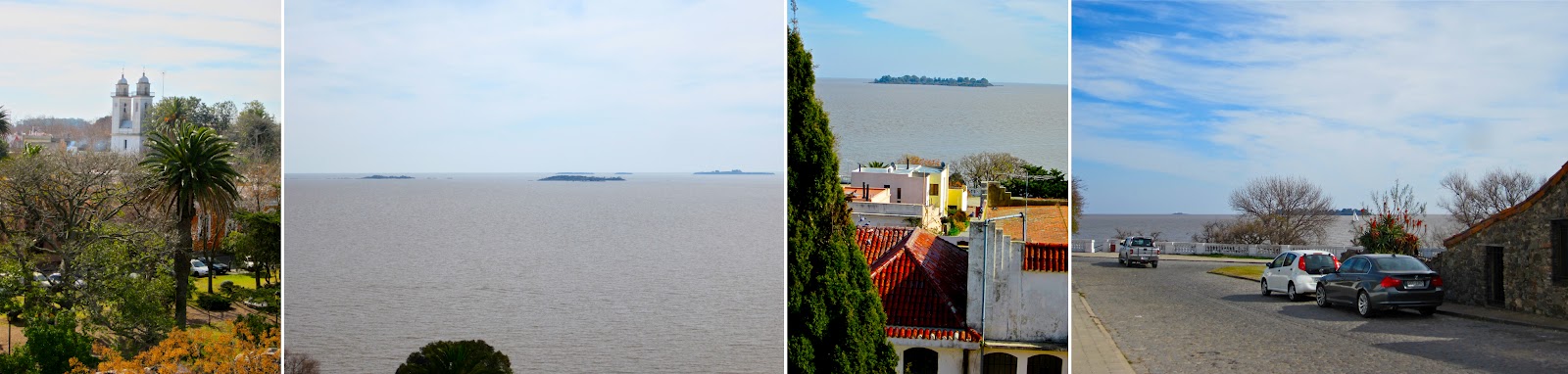
The view was worth the trouble/Vale la Pena. What struck me was that there are nearby islands just off the coast in the river (in Argentina waters). One island, about 3.5 kilometers away has another lighthouse on it. The last photo while not taken from on top of the lighthouse, shows the island with the other lighthouse on it.

Colonia has many charming dinning spots tucked into every nook and cranny. One is in an old round mill tower that has now been turned into a restaurant. Another popular place is called El Drug Store, a colorful place with an antique car parked outside. If there are only 2 of you and you reserve the car ahead of time, you can eat inside the car at a tiny table between the steering wheel and the back seat, while sitting on the back seat like a booth. A friend named Syd wrote about eating at the restaurant, he ate inside the building. The menu was extensive and the food he said was good and reasonable about $20 per person, on the weekends there is live music to eat by. When in Colonia make sure to look into every doorway in order to scout out a restaurant or ice cream parlor. Be aware that many of the restaurants charge a cover charge, added to your bill, it's called a "cubierto".  Because this is a tourist spot (trap is too harsh) these cover charges can be expensive, anywhere from 70 pesos on up, depending on the individual restaurant. Many places have this amount listed outside but ask first.


By far the most charming Colonia mealtime atmosphere came however from the many scenes of outdoor dinners eating at tables in the streets. Go on a warm/ hot day and definitely eat outside along with the others to really feel like you are on vacation. That gives you the so-called European vibe that people claim Uruguay has over other Latin American countries.


Colonia has about 8 different mini museums and you can buy a single general admission ticket at the municipal museum that allows you to enter them all (or most???) These museums range from examples of furniture, architecture, archives of the history of the area, nautical finds and Pirate lore, there is even a tile museum (blue and white mostly). So keep your ticket.

Wally and I found out (to late for us to use) that there is also a tour bus circuit, like Buenos Aires had, which features 10 places of interest, lined out on a bus route map. You can buy a "day ticket" and hop on that bus and hop back off at will, at any and all of the designated stops to see the landmark/sights. I believe you can buy the ticket either on the bus or ask at the tourist info. building outside the old Gate.

The beauty of Colonia is being able to take your time and peek into nooks and crannies to discover lovely vignettes. Look up and notice the Spanish moss growing on the trees. Palm trees, orange trees full of fruit in the main square and sycamore trees line the streets.


Uruguay is a small country and Colonia is a small town, many people say, it only takes a day to sight see in. Of course, you are missing the point of Uruguay all together, if you were to take that attitude about everything here. Uruguay is a peaceful, relaxing country in comparison to say, Argentina, so whenever visiting Uruguay slow down. Don't expect to be constantly entertained, wowed and hustled from one sightseeing land mark to another, take your time, relax, go to the beach or just wander around slowly enjoying the moments, look for the micro views in addition to the bigger picture. Sometimes we have to be reminded to "STOP and smell the roses" and that takes time.

Monday, August 20, 2012

The Train Station, Old and New!


I love looking at stately old buildings and imagining what they were like in their glory days. Most of my early photos albums have more pictures of places than people in them (yeah, kind of sad). Still, I love architectural design so I usually snap a photo or two of some structure whenever I go out.


Montevideo, the capital city of Uruguay has often been touted as a very European inspired city rather than, an adobe pueblo style that people might imagine a Latin American country would be like.

The old, General Artigas Central Railway Station is a beautiful example of Victorian architecture. It was the former central railway station of Montevideo. It is located near the port area between the streets Paraguay, and Rio Negro in a barrio (neighborhood) called Aguada.

It is truly heartbreaking to see such a grand building left to decay and squalor. There are several U-Tube videos online showing the extent of this degradation. So suddenly, has it deteriorated that I had to find out when it was built and when it was last used as a working station.


The station opened, July 15, 1897.  Built by the English when they were the owners and directors of the Uruguayan railway system here (which was nationalized in 1949). It was designed by an Italian engineer/architect named Luigi  Andreoni (Luis) who also designed other buildings in the capital city such as the neoclassical Italian Hospital (founded in 1890 and located in the Tres Cruces area at the intersection of Avenida Italia and Artigas Blvd; and also the Club Uruguay (of the year,1888) located in the Plaza Matriz.

Despite being called the General Artigas Station (a local Hero here) the front of the station has not only a statue of the General but several statues of other famous historical personages as well. One is a statue of Denis Papin who among other things was an inventor known for his "steam digester", the forerunner of the stream engine. James WattGeorge Stephenson and Alessandro Volta are the other people who have statues in their likenesses here.

Because this is such a little country with limited finances it was determined that Railway service and especially passenger service railway lines were too costly to maintain. Carrying freight by trucks and Bus service for passengers was pushed as an alternative, (some heavy load cargo trains have continued to be used). Long distant passenger service trains ended their routes.  Most of the nearly 2,900 km of railway tracks in this country have declined into disuse. Many little railway stations are abandoned. The majority of the passenger lines stop being used in 1988. The current president José Mujica originally made election promises to revitalize these lines and some 422 km are being renovated.

There is a movie that highlights the end of this train era for Uruguay. The movie is called, El último tren (The last Train). It's a 2002, comedy/drama that was shown at the Montréal World Film Festival and won a film honor for Best Latin-American Film. The movie is set in Uruguay, it shows how special the trains were to the people of Uruguay.


The last train of passengers inbound, ever to use this old central station arrived there, February 28th, 2003 at 21:25 (9:25pm), the last train to leave this station then left empty at 21:40 (9:40 pm.) and on February 28th, 2003, the station was closed. Many people here remember visiting this old station when it was alive and well and have remarked on its beauty. The iron work used in it's iron fretwork was imported from a foundry in the district of Derbyshire, England, the Andrew Handyside and Co. foundry. It had to travel almost 7,000 miles (6820.77 miles 10976.9 km.), halfway around the world in 1895 to get here.

Some groups tried to save this station for its original purpose. For awhile (in 2005) one such group called the "Group of passengers for the defense of the central station", seemed like they would be successful. People talked about the freight trains and passenger trains returning to this station as well as making this "historical monument", viable as an income producing source if the Ministry of Tourism were to also get involved. They failed to get the governments' support. Earlier, in 1998 the State Railway Administration or Administración of ferrocarriles del Estado (AFE), sold the station (and 6 hectares of land) to the Real estate mortgage bank of Uruguay (BHU). From these sales the AFE used part of the money to build a new modern railway station about 1/2 mile north of this site. The money they are saving from the repairing and upkeep of the old station they feel, they can invest in other railway projects. The AFE restored an old steam engine and 2 passengers cars that I posted about last month.

Abandoned building with imported English ironwork trim.
It has only been 9 years since this station has been completely abandoned with zero maintenance and the results are shocking! Vagrants sleep in its doorways. The smell of urine abounds and the ceilings inside, what's still left of them that is, leak. I would have explored a little inside (there are wide gaps in the lockout fence) but the area is desolate and dangerous now. Walking by it during the day wasn't so bad but in the evening avoid this area. There are currently no plans in place to revitalized or reuse this train station.

Empty train yard and buildings of the old station.
The new central railway station for Montevideo, is a modern style building, it's a walkable 1/2 mile (to the north) from the old one. It was opened March 1st, 2003.  It is very,very small in comparison with the older one. It has only 3 tracks with little maneuvering grounds for the trains, such as freight trains. There is some passenger service that uses this new station, the few commuters from nearby towns use this station. There is service to the city called August 25 (25 de Agosto), and also to the barrio of Peñarol. Schedules have to be checked though.  


Trains and train service nowadays in Uruguay can't compare with the glory days of service when the iron rail ruled but there have been some attempts at rethinking the value of the rail. There is talk of a train service from Buenos Aires, Argentina to Montevideo, Uruguay, a joint venture between the two countries. A test run took place in September, 2011. Let's hope the future will see a few more opportunities to ride by rail.

I also hope that the old central station will be restored one day (for whatever, honorable use). That structure, along with the many other beautiful but decaying buildings in Uruguay all deserve attention. There is such a rich history here in Uruguay and such old buildings help keep that history alive.

Tuesday, July 31, 2012

La Barra and Its Art!


Well, our weekend guests have gone back to the USA. They spend their time between the United States and their future retirement condo in Buenos Aires, Argentina. You can take a peek at Tom and Nancy's  place (by clinking on the link) from the time we visited them in Argentina a few years ago. I must say, how pleased I was at how well our tiny little guest room functioned! Barney (our black dog) jumped up on Nancy (only once) when she first came into the house and I'm afraid that soured things a bit for her. Our dogs always get excited on arrivals. They were great during the visit except for that incident.

One benefit of having house guests stay over is getting my house into "super clean" picture perfect mode. Another side benefit is playing, tour guide and seeing places we normally don't get to visit. These house guests like to go to museums and art galleries, so we went up the coast to La Barra.


La Barra is past Punta Del Este by just a smidgen (20 kilometers from the peninsula). When going to La Barra after leaving the back side of Punte del Este you get to go over the short but famous "Wavy bridge".  It was designed by an Uruguayan engineer named Leonel Viera back in 1965. Nowadays, there are actually 2 undulating (wavy) bridges parrelling each other . Each one serves a different traffic direction (one way each)  It's a fun sight for visitors to see and cross over as you leave Punta Del Este. La Barra is just one of the many beach towns up the coast. The name La Barra comes from the term sand bar. The estuary formed by the Maldonado creek (Fresh water) is barred from totally mixing with the Atlantic Ocean (salt water) by, you guessed it, a large sand bar. Depending on the weather however, the size and shape of this natural barrier can sift and change.

La Barra used to be a small fishing village and a second summer home choice for vacationers from the nearby town of San Carlos. It has since morphed into a swinging neighborhood bar hopping, all night clubbing destination spot for the young. It has a well known beach hangout called bikini beach, that is a party zone with a Beach DJ and drink service.

La Barra unfortunately is no longer a bargain. Hotels and Restaurants there are very expensive, drawing the rich and famous from nearby Punta Del Este. Bar hopping often starts at sunset and then the night clubs stay open till sunrise. I hear that the main street of the town really comes alive at night. Wally and I don't have the resources or stamina to go there for the all night revelry, so I afraid I can't give you any firsthand advice on the club scene there.

Our friends as I mentioned, have a thing for art galleries so we took a day trip to La Barra in order to wander through it's several art galleries. There we met Roberto Fernández Ibáñez a Fine Art Photographer who has a shop in a cool little complex of other shops. He is Uruguayan but has had his work shown internationally. He's won awards. He has taken part in the Prize Discoveries Festival de la Luz (festival of light) held in Argentina and been awarded. He was one of 9 photographers selected worldwide to exhibit at FotoFest International Discoveries, in Houston Texas, USA. His work is also cited in a number of publications on contemporary photography and Photography from Latin American. He has shot a collection of Black and White photos which plays on the theme "Photo meets a bit of reality" (my words).


I am including a scan from his informational photo biography card. It's interesting that he says he has a special technique that can bring out some color in black and white film usage. He has offered to have us come back to visit him and show us how it's done. I wish I was a knowledgeable photographer  so as to better appreciate and learn from such a demonstration.

Besides his shop, we wandered through the complex he shares and enjoyed dashing in the various shops to look at their offerings. My friends bought a butter-knife with a bone handle. Who knew that sheep and horse bone could be polished up so well as to make a lovely handle.


A really cool looking art gallery was just up the street from Roberto. It's floors were covered with antique rugs and the building featured the artwork of one man.  I'm afraid that I don't know who that man was, as the shop was open but the artist or shop keeper (?) was relaxing with his young son in the building's beautiful backyard. The shop carried the name Zuloaga. I must admit that I didn't know what that iconic name referred to, so I did an online search later. My friends are the art connoisseurs not I, they have even bought (invested in) some high priced modern artwork which graces their home's walls. Still like myself Spanish artwork is not too well known to us, other than Goya and Picasso. I am glad, that I now know through my computer search why this man's name was chosen as an iconic name to announce this gallery. Like saying the legendary one name "Cher" or "Madonna" "Zuloaga" is to Spanish Art., what those names are to pop music. I thought you might like a similar introduction to some Spanish artwork through theses links! The artwork in Zuloaga is an impressionistic style unlike the namesake's art.


I'm not too enamored with modern,"surreal"artwork unlike my friends. However, I did find the paintings in Zuloaga mesmerizing. The paintings were also huge which was a reminder to me of the house and wall size needed by the rich and famous to display such pieces. So without a purchase, we left.


Walking down the street on this nice sunny day, our group came upon the many antique shops lining the block. Unlike the local "remates"(junk shops) in my town, these items were in good condition ready to add a charming element to any home. I could only take a quick peek at those shop's wares. That's the down side of traveling in a group. My house guests aren't "into" cutesy comfy cottage type stuff. They were driving, so I had to go with their desires this trip. I took a few photos instead.


My house guests found it interesting that we have flea markets in Uruguay called, "Mercado de Pulgas"(flea market). Following the directional sign we found the street where the flea market was to be held. Unfortunately, they don't set up until 5:00 pm and it was only 3:00 pm. The La Barra flea market is held only on Saturday and Sunday afternoons starting at 5:00 PM. and on up to 8 or 9PM.


Although, disappointed at not searching through a flea market, I was pleasantly surprised to come across some unexpected open air artwork. There looked to be, some kind of 1 room school building that taught art. In front of the building was an amazing display of paintings attached to wooded posts. I was impressed with both the number of paintings and the quality of the work. Any information you readers can supply on this school, I'd appreciate learning it's story.


All in all, having visitors come and stay with me, often introduces me to things that I might not be normally exposed to because of my different tastes and preferences. Visiting places with them can be fun. Still, I think these short excursions end up being only an introduction to a place for me (kinda of like these posts are to you). I know, that I want to revisit these places again in the future. Next time, Wally and I will come alone, just the two of us together. This way we can take our time and explore to our (my) heart's content.

Monday, July 16, 2012

You Cant' Always Get What You Want

I decided that I would share a little of what we, as expats far from our native land, view as "comfort foods" and what you can and cannot have in Uruguay. We have been experimenting with adding to our repertoire of recipes and have been able to get a few more foods from "home" (though Uruguay is our home now).

You can't get corn tortillas. The caustic and environmentally dangerous processes (which I commented on earlier) needed to produce the masa for corn tortillas, is unknown in Uruguay. Obviously we have been able to make flour tortillas. However, homemade flour tortillas are not anything like store brand tortillas. In the store they are uniform size and very, very flat (about 1/8" thick). Home made tortillas, on the other hand, vary from round to any other shape you can imagine and are very, very thick, usually about 1/4-3/8" thick. I have tried everything I know to make them thinner, but it just has not worked (if anyone knows the secret of producing uniformly thin flour tortillas, please share). They are closer to peasant bread (I don't know if this is a real designation, but I am using it). Not to say that they are not delicious, but they are not what we were used to. So you get the drift. You can have some things, but you can't always get what you want....

However, we recently were able to buy and cook chicken wings. I had seen a package, in Tienda Inglesa, but only found them once or twice. Most meat, however, is purchased at your local butcher. So, the other day, when I was shopping, I asked him what he did with the wings, knowing that they sell chicken breasts and also the leg and thigh combination (muslo), but wondered what they did with the little wing and drummette. Turns out they sell them (happily) for about $1.25/lb. They are called "alitas". I was able to get a kilo (2.2 lbs), cook them up, make a little BBQ sauce* and we feasted on "wings". Denise and I had sampled wings at the "Anchor Bar" in Buffalo, NY in about 1983- before buffalo wings became such a big deal. Now, we can enjoy them on a South American beach, while sipping down our favorite beverage. If you try sometimes, you just might find- you get what you need.

The other day, a mentor of ours (Deby), who has lived in Uruguay for over 10 years, shared a recipe for butterhorn rolls and also cake donuts. I was somewhat hesitant to try them, but eventually (after Denise begged), I tried the butterhorn recipe. I was very impressed. The basic recipe made 36 rolls and they freeze nicely, as well. We enjoyed them with soups, and with morning coffee. Very tasty.
Butterhorn Rolls

1 cup milk scalded
1/2 cup oil
1/2 Cup sugar
1 teaspoon salt
1 package instant yeast (2 1/4 tsp)
3 eggs
4 and 1/2 cups good flour (0000) here

Combine: milk, oil, sugar, salt - then cool to lukewarm. (not cold but not hot). Add the yeast that has been dissolved in 1/3 Cup warm med. warm (not hot) water- stir it well.

Add eggs beat them a little bit, then add the flour, half the flour first, stir, then add the rest,,,,mix to a smooth dough. It will be very, very wet. Turn out on a well-floured surface and knead until it is a smooth dough. Place in a greased bowl, cover and let rise until doubled.

Divide dough in 3 even balls .

Roll each ball on lightly floured surface with a rolling pin in a circle a perfect circle 9 to 10 inches around..... Brush with melted butter (real butter )cut each circle with a sharp knife, in 4 pieces now cut each of these in 3 roll each piece from the fat end to the point end. Place the point end side of the roll down on the greased pan so they stay looking nice..

Arrange in a greased baking pan allow 2 to 3 inches apart at least. Brush with melted butter again

Cover and let rise again until very light doubled. or so put in hot oven 400° to 425° (here a little over 200°) for 15 minutes- let sit in pan. I bush them again with butter to make them shine ... watch them !! don't burn them........

You will get 36. Right out of the oven they are wonderful...


Yesterday, I tried the doughnut recipe. I had been putting it off, because I was thinking of raised doughnut and  all that was involved. However, cake doughnut are just the easiest things ever. In less than 15 minutes (the time it took the oil to heat up), I was making the doughnut and minutes later, enjoying them. I am now tempted to locate one of those "Krispy Kreme" recipes you see all over, and try them. Make sure not to overcook them. I was used to seeing cake doughnuts a little darker and I fried them a little too long. I think a light brown will do for next time. Of course, this did not make them inedible- to the contrary they were delicious, but will be better the next time (and there will be a next time).

Cake Doughnuts
2 cups flour
3/4 cup sugar
1 teaspoon salt
1 Tablespoon baking powder *
1 teaspoon cinnamon
1 teaspoon nutmeg
2 Tablespoons melted butter
1/2 cup milk
1 egg

Mix all the dry ingredients together and stir till well blended,,, add the egg, milk, and butter mix well form a ball . lay out on floured waxed paper and kneed the dough 20 times add a LITTLE bit of flour so it is not sticky . add more flour to the waxed paper and roll out flat and even, cut doughnuts about 1/2 inch each ... if you do not have a doughnut cutter use a plastic glass, then make the whole with "a top of a large pop bottle".

I don't mess with the frying holes anymore I gather all the holes dough up and just make another doughnut.

Get a skillet put oil in it at least half full get the oil hot then fry 5 or so at a time. watch them very well do not burn them they have to be fried on both sides.
Take them out drain on paper towels. then put them on a wrack to cool . Then ice them .

This recipe should make 11 or 12. (don't roll these too thick..)..and no holes to fry...

OR roll them in cinnamon and sugar when they are just out of the frying pan.( the recipe says dip them quickly in melted butter so the sugar and cinnamon stick.)


Chocolate Glaze This is a chocolate glaze for coating doughnuts.
Ingredients
• 2 Tbsp. Butter or Margarine
• 2 cups Confectioner's Sugar
• 1 Tbsp. Cocoa Powder
• 1/4 cup Milk
Directions
Melt the butter in a sauce pan. Sift the confectioner's sugar and cocoa powder into it. Stir while adding milk until smooth.


Now- on to biscuits (or baking powder biscuits). I have been making biscuits for years, now, using a recipe in the Betty Crocker cookbook (the recipe is so simple- it's not worth including). Try as hard as I might, I could never get them to rise, properly. They were always flat and a little hard. Needless to say, we didn't have them often. Now, with the discovery of lard (graso de cerdo), and the fact that I needed to use twice the amount of baking powder, I have produced very light, fluffy biscuits. I prefer working lard into the dough, rather than butter (much easier) and only folding the dough no more than 10 times produced a very nice biscuit. Also I took care to cut the biscuits cleanly- not twisting the cutter- thereby sealing the edges and preventing rising during the baking. So biscuits are back on the menu.

I received a recipe to make sour cream from scratch and so I tried it. It was not one of my finest attempts. The recipe calls for a cup or so of natural cream and a tablespoon of natural yoghurt. Our friend in Punta del Este even sent me photos of the proper brands to buy and I followed the recipe to a "T". Of course the recipe was, mix a tablespoon of yogurt to 250 ml of "crema de leche" and sit for 24 hours, covered. What could be simpler?

Crema de Leche is very sweet and thick. You could spoon it over fresh peaches, any day, and have a fantastic dessert, with no sugar. Anyway- after sitting at room temperature for over 5 days, I do not have sour cream. What I have is slightly less sweet cream than I started out with. Something has gone terribly wrong. What- I don't know.

Anyway- until proven wrong (and I hope I am) I will consider sour cream something you can't get here. There are products that closely approximate sour cream, but not the real deal.

* A little note on BBQ sauce. Some years ago we were invited to a BBQ and they cook had such a delicious sauce that I asked him about it. He took me aside and made me swear not to tell the guests his secret. He took ketchup, brown sugar, vinegar, hot sauce and a little of the cheapest BBQ sauce you can get in the store. When it was mixed together, it tasted divine. I have always followed that and have never had any complaints.


** I learned an interesting fact, the other day for cooking in Uruguay. In the US, almost all baking powder is what they call "double acting"- meaning it contains two types of acids that react at different times in the cooking process. The baking powder that I have been buying is not, so I need to double the amount that I would normally use.

Sunday, July 1, 2012

Good Neighbors!!


My next door neighbor recently got his house re-roofed. His house went from a tin roof design to a new tile roof. The process was interesting to watch. I have always loved architecture so I couldn't help but keep an eye on the daily progress of the roofing job. I must have a thing about roofs because I also did a post a while back on the process of re-thatching a roof here in Uruguay, the roof of some expat pals Wayne and Janet. So by reading this blog you can see 3 examples of roofing materials used here in Uruguay, tin, tile and thatch or the three t's! We have a cement roof.

Our neighbors' house with his former green tin roof.
Uruguay doesn't have a monsoon season because it's not a tropical place but it does have 4 mildly distinct seasons. Winter is just as dreary and rainy here as in most places that have a winter season just without snow. The disadvantage of a tin roof is that it can mean a cold interior house temperature in winter as our neighbor attests too. Also, when it does rain here it can be annoyingly loud at times with the rain constantly beating above your head on a tin roof. So our neighbor decided to switch over to tile.


Still, you might wonder what my neighbors' roof tile job has to do with the title of this post. How did his new roof affect us? Take a look at the the finished title photo and then down to the next photo of the view from my front patio towards the neighbor's house. Can you see that the original view is partially blocked by these two towering trees?

These two tree trunks, belonged (as in past tense)  to 2 pine trees on my property. Despite being ugly as all get out they did manage to cast some appreciated shadows upon my patio during summertime. So I didn't mind their appearance. My neighbor on the other hand only saw danger and possible death (okay, a little dramatic), every time he looked at them. Now, with the expense of a new tile roof on his house, he really wanted to see these possibly dangerous trees go. Two years ago, he tried to get us to fell these trees but since we don't have money anymore and liked the shadows they cast we said, "NO!", to their being cut down (he still had a tin roof back then). This time with the tile roof coming he tried a new and more convincing tactic. He showed us photos from a recent windstorm and the downed trees that it caused.


These are photos from the next block over from us and our neighbor, (Avenue Del Mar) of downed trees from a December wind storm. The month of December is summer here but due to some heavy rains and then winds, several trees went down. The first photo's date says December 2012, which hasn't occurred yet. I think he wrote this down as a way to show us non-Spanish speakers that these photos were recent, since this is 2012. The second photo has the correct date of December 2011. Still, that was only 6 months ago and with winter threatening to bring more rain and storms and with his new tile roof at stake he wanted those trees gone.


Our neighbor then tried to further persuade us using, the sympathy card, by showing us 2 more photos, this time of his mothers' place who also lives in our town. At her house, a tree came down and wiped out her parrilla (BBQ area) and nicked the top of her houses' roof.


Okay, being that floods, storms and trees coming down are usually considered "Acts of God" and not covered when it comes to insurance claims, we could see his point in wanting the trees gone. Still, we really don't have money to spend on trees, so our good neighbor allowed us to be good neighbors in cutting down the trees by paying for their removal himself. So his roof replacement definitely ended up impacting us both.

He sent the tree guys over to chop down our two trees. That has happened before on our property, still it is kinda scary to watch. It is amazing that the company usually has one guy whose sole job is to handle and throw the ropes up and over the trees' top, these will (hopefully) guide the trees' fall.

They have another guy who can climb these tall trees just like a mono or monkey. The climber doesn't use a safety harness nor the thrown ropes in order to reach the top of the tree, not even special shoes or gloves, he just goes for it and climbs. This guy just climbed up to the top in his bedroom slippers!


Our good neighbor paid for the whole thing! This crew even had a huge tractor to help keep the ropes taunt during the somewhat controlled down fall. The tree crew also ties the ropes around existing trees to help guide the fall.  This time because we had 2 trees coming down, I did wince a little bit but all went well and the crew cleaned up the debris. I had to sweep my own patio from all of the saw dust.


Our patio maybe a little hotter come this summer but the heat will be worth it in order to keep in good with our neighbor and to generally be and stay, good neighbors all around.